Simplifying Frequency Stability for High-Speed 5G and Data Converter Designs
資料提供者:DigiKey 北美編輯群
2026-03-25
The frequency source is often the hidden bottleneck in high-speed data converter and 5G radio designs. As data rates climb and 5G pushes into higher frequency bands, performance demands become dramatically harder to meet. The list of requirements keeps growing, often in directions that conflict with performance goals.
Like the foundation of a building, if the frequency source shifts, everything built on top of it is compromised. The clock or local voltage control oscillator (VCO) is that foundation, and any instability there propagates through the entire system, where no amount of careful design elsewhere can fix it.
At the heart of every frequency synthesizer is a phase-locked loop, or PLL. The PLL is the mechanism that locks the output frequency to a precise reference and holds it there. It's what separates a stable, controllable frequency source from an oscillator that drifts.
Modern applications such as radios, radar, phased arrays, multiband test equipment, and wireless infrastructure constantly hop between frequencies to avoid interference, support multiple channels, or steer beams electronically. Every time a system changes frequency, its PLL must relock. Until that happens, the signal is unstable and essentially unusable. That relock time directly affects how fast the overall product can respond.
A data converter works by measuring an incoming signal at precise, regular intervals—often millions of times per second. The clock determines when each measurement is taken. Any timing uncertainty in that clock, known as jitter, means measurements are taken at the wrong moment, introducing errors that look like noise on the output. The faster the signal, the worse the effect.
In 5G radios the same problem appears in a different form. The local oscillator places the radio's signal precisely on the correct frequency. Phase noise in the clock source translates into sampling jitter, which directly limits converter signal-to-noise ratio (SNR) and ultimately contributes to system-level metrics such as error vector magnitude (EVM).
In both cases, the result is the same: Uncertainty in the frequency source introduces errors that cannot be corrected downstream. A converter specified for exceptional dynamic performance can only achieve its target numbers if the clock driving it is equally precise.
In practice, the synthesizer's phase noise determines how much timing uncertainty accumulates in the clock signal—expressed as RMS jitter, a single figure representing the average magnitude of those timing errors—and therefore how much of the converter's noise and distortion budget is consumed before the signal is even digitized.
Design considerations
When designing high-speed data converters and 5G applications, it's important to consider the tradeoffs that can impact performance:
- Phase noise determines the noise floor, setting the ceiling on dynamic range for the best signal clarity that can be achieved, regardless of how good everything else is. In a 5G radio, it determines whether the modulation scheme is even decodable at the receiver.
- Frequency range determines flexibility. A synthesizer that covers the target band without external multiplication or division simplifies the design, reduces component count, and eliminates the noise and complexity introduced by those extra stages.
- Lock time determines how fast the system can change channels or respond to dynamic conditions—critical in frequency-hopping and beam-steering applications.
A PLL locks onto a frequency by continuously comparing its output to a reference and making corrections. This correction process is governed by a feedback loop, and like any feedback loop, it takes time to settle as the loop must detect the error, respond to it, and stabilize before the output is usable.
In traditional designs, the same loop bandwidth that determines how quickly the PLL can respond also directly affects phase noise performance. Widening the loop to lock faster worsens phase noise. Narrowing the loop to improve phase noise negatively impacts lock time. This fundamental tradeoff meant that designers had to choose which mattered more for their application—and live with the consequences of that choice.
The latest generation of integrated fractional-N synthesizers addresses these tradeoffs directly. Where earlier solutions forced designers to choose between phase noise performance and integration level, newer devices combine ultra-low phase noise with wide frequency coverage, fast lock times, and a compact footprint, consolidating what previously required multiple discrete components into a single solution.
For data converter clocking, this means the noise floor of the frequency source is no longer the limiting factor in system dynamic range. For 5G radio designs, it means hitting demanding error vector magnitude targets becomes a frequency source problem that's already been solved, rather than one that must be engineered around.
Modern RF systems typically generate sampling clocks and local oscillators using fractional-N PLL synthesizers. While these architectures allow extremely fine frequency resolution, the modulation of the divider ratio introduces quantization noise and fractional spurs that contribute to the overall phase-noise profile. Noise from an amplifier or filter affects the signal, but noise from the frequency source corrupts the reference, and a bad reference undermines every block that relies on it.
On-chip VCO simplifies board design
Wideband frequency synthesis has traditionally meant assembling a signal chain from discrete components—external VCO, PLL, buffers, and the layout headaches that come with them. Analog Devices, Inc. (ADI) simplifies board design with solutions that integrate the VCO on-chip, collapsing that chain into a single device with fast calibration for frequency hopping, without sacrificing the phase noise and jitter performance needed by 5G radio and high-speed data converter designs.
Changing frequency isn’t instantaneous. When a PLL is instructed to transition to a new frequency, it undergoes three distinct stages before the output becomes usable. Initially, it receives the command to change. Subsequently, it internally searches for the appropriate settings to generate the desired frequency; this search phase is the slowest part, typically taking anywhere from 100 to 250 microseconds in a modern wideband device. Finally, it stabilizes, ensuring the output is clean enough for use.
ADI’s ADF4382 family attacks the slow middle step directly. Rather than performing a fresh search every time a frequency change is requested, for fast calibration it uses an on-chip lookup table with 32 pre-calculated settings at known points across its frequency range. When a new frequency is requested, it finds the two nearest stored points and interpolates between them to arrive at the right settings almost instantly. That cuts the total lock time to less than 10 microseconds and as low as 2 microseconds.
Three devices feature a VCO with two cores and 512 overlapping bands. They also share the same figure of merit (−239 dBc/Hz), the same ultra-low jitter performance, and the same fast calibration capability. What differentiates them is frequency coverage:
- The ADF4382 (Figure 1) covers 687.5 MHz to 22 GHz at the output, making it the highest-reaching member of the family, and the natural starting point for mmWave 5G radio designs and other applications such as wideband radar and test instrumentation that need to operate at the upper end of the frequency range.
Figure 1: Schematic illustrating the functional architecture of the ADF4382, with an integrated high-frequency VCO operating from 11 GHz to 22 GHz. An internal RF output divider provides selectable output frequencies (÷1/2/4/8/16) while differential RF output buffers deliver the final signal. (Image source: Analog Devices, Inc.)
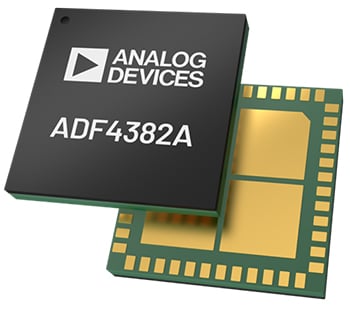
- The ADF4382A (Figure 2) is recommended for high-performance data converter clocking, covering 2.87 GHz to 21 GHz at the output, with automatic alignment of its output to the input reference edge across multiple outputs. This allows for designs using multiple converters clocked from the same source with consistent timing relationships.
Figure 2: The ADF4382A is optimized for demanding clocking applications in high-speed data-converter systems. (Image source: Analog Devices, Inc.)
- The ADF4383 (Figure 3) extends coverage downward relative to the ADF4382, broadening applicability to designs operating in lower frequency bands while retaining the full performance architecture of the family, including fast calibration and the same figure of merit. It shifts the VCO range slightly downward to 10 GHz to 20 GHz, enabling output frequencies down to 625 MHz with internal dividers. It delivers improved phase-noise performance, making it well-suited to systems requiring exceptionally clean microwave clocks and local oscillators.
Figure 3: The ADF4383 expands coverage into lower microwave bands while delivering even cleaner clock generation for high-performance RF and data-converter applications. (Image source: Analog Devices, Inc.)
All three variants utilize an output divider architecture. The ADF4382 and ADF4383 dividers support divide ratios of 1, 2, 4, 8, and 16. The ADF4382A features divide-by-2 and divide-by-4 output dividers that generate frequencies in two specific sub-ranges, respectively 5.75 GHz to 10.5 GHz and 2.875 GHz to 5.25 GHz.
This architecture allows designers to translate each component's high fundamental VCO frequency down to an appropriate clock or local oscillator frequency for specific design requirements. Because the output divider sits inside the PLL feedback loop, the output can be automatically aligned to the input reference edge, which simplifies multi-chip synchronization considerably.
Resolving hardware issues with software
The ADF4382 family's programmable reference-to-output delay with sub-picosecond resolution means that timing relationships between devices can be dialed in through software rather than depending entirely on precise board layout. Thus, a historically difficult hardware problem becomes a manageable programmable issue.
When using fast calibration, the lookup table should be regenerated if operating temperature drifts more than ±20°C from the temperature at which it was created. For designs that combine wide temperature operation with rapid frequency changes, such as automotive or industrial outdoor applications, this becomes a straightforward firmware consideration rather than a fundamental limitation.
For a product designer, the selection process is simple. Identify the target output frequency, check which variant's range covers it cleanly without requiring external multiplication or division, and select accordingly. In most cases the device's internal output dividers will handle the translation from the fundamental VCO frequency down to whatever clock or local oscillator frequency the specific design needs. Whichever variant fits the application, the underlying performance architecture is the same—the same figure of merit, the same fast calibration capability, and the same integration benefits.
Conclusion
By reducing frequency switching time, ADI's ADF4382, ADF4382A, and ADF4383 fractional-N PLLs are aimed at making frequency-hopping designs faster, more responsive, and more efficient without adding timing risk. If requirements shift, designs translate cleanly from one variant to another due to their shared architecture.
聲明:各作者及/或論壇參與者於本網站所發表之意見、理念和觀點,概不反映 DigiKey 的意見、理念和觀點,亦非 DigiKey 的正式原則。