Settings
 Fast Delivery
 Free Shipping
 Incoterms
 Payment Types


 Marketplace Product

How to Overcome Linux Development Hurdles in Resource-Constrained Systems
Contributed By DigiKey's North American Editors
2026-03-12
Open-source technology presents electronic system developers with a path to lower costs, faster time-to-market, and extended product lifecycles by removing proprietary roadblocks and fostering collaboration. Today, open-source opportunities span the entire system stack, from operating systems to single-board computer (SBC) hardware and semiconductor IP.
However, high computational requirements, security risks, and deterministic latency challenges remain for running Linux on resource-constrained devices, such as industrial IoT (IIoT) and robotics systems.
This article briefly reviews the challenges designers face when deploying Linux in resource-constrained systems. It then introduces BeagleBoard.org’s BeagleV-Fire SBC in combination with Linux, and describes how it can maximize future design flexibility. Included is a demonstration of how to use Microchip Technology’s open-source board support packages (BSPs) to build an initial Linux configuration.
The challenges of open-source development in embedded systems
The adoption of open-source technologies in embedded development is well established. Both hardware design and software integration are accelerated by ready-to-go assets produced by a wide ecosystem of manufacturers and individual engineers. In particular, Linux's flexibility made it a leading software solution for systems that require networking, high-level application frameworks, and artificial intelligence (AI) integration.
However, deploying Linux on more resource-constrained devices introduces additional considerations:
- Computational demands: Traditional microcontroller units (MCUs) struggle to meet the memory and storage requirements of even minimal Linux distributions. As developers add background services to support applications, subsystems, and user-space frameworks (USF), these subsystems consume more resources, making bulky software stacks unviable.
- Latency: High-precision applications such as robotics and industrial automation demand predictable timing for system coordination and operational safety. While the Linux kernel’s PREEMPT_RT feature improves determinism, dedicated real-time operating systems (RTOSs) offer lower latency and overhead for resource-constrained hardware.
- Security: Embedded systems deployed in public environments are at risk of unauthorized access, making standard security measures such as secure boot, tamper resistance, and hardware Root of Trust (RoT) critical. In addition, regulations such as the EU Cyber Resilience Act (CRA) mandate that products with digital elements be secure by design.
- Power: Edge devices often run in remote environments with limited power resources. Higher energy efficiency can extend battery life or enable operation using ambient energy sources. Similarly, greater power efficiency can simplify thermal management and boost performance per watt, supporting advanced edge processing.
- Lifecycle management: The CRA requires digital devices to be supported for at least five years, although many industrial deployments require 10 to 15 years of product availability. Thus, to ensure consistent Linux kernel support, developers must plan for upgradeability and hardware availability.
To overcome these challenges, developers can draw on additional resources from the open-source and embedded Linux ecosystems and leverage Linux's streamlined hardware-software combinations for rapidly evolving edge applications.
Linux implementation using open SBCs and RISC-V
While general-purpose Linux distributions provide a fast path to application readiness, they often include packages and services that are not required for the project at hand. In contrast, the Yocto Project, powered by OpenEmbedded, lets developers build custom Linux images tailored to specific use cases. This eliminates unnecessary features, allowing lightweight distributions to run on resource-constrained hardware while retaining advanced capabilities, such as AI-driven computer vision or predictive maintenance via standard tooling.
In addition, the Yocto Project provides developers with:
- Reproducible builds for long-term maintenance
- Custom kernel configuration to improve performance, security, and responsiveness
- Board-specific layer integration to ensure hardware-software compatibility and reduce development time
Simple integration with over-the-air (OTA) update mechanisms such as SWUpdate, RAUC, and Mender also helps developers regularly improve device performance and security throughout long product lifecycles. As a result, the Yocto Project is now standard for embedded Linux systems.
Similarly, open-source SBCs have long been employed to accelerate Linux application development, providing a ready-to-use reference platform that combines processing, memory, storage, and I/O resources in a self-contained form factor. With open SBCs, developers can quickly prototype a system, validate their software stack, and then transition onto custom hardware with minimal rework.
The RISC-V open-standard instruction set architecture (ISA) takes this a step further by allowing system designers to create customized processing platforms without expensive licensing fees. With RISC-V, designers can choose which parts of the instruction set to include and even extend them to meet their specific use cases. Since the original designs were created with a Berkeley Software Distribution (BSD) license, derivative works can be either open and free or closed and proprietary.
For developers and architects, the Yocto Project, open SBCs, and RISC-V reduce reliance on single-vendor roadmaps, increasing long-term design flexibility. Moreover, growing upstream support for RISC-V in Linux and RISC-V's platinum membership in the Yocto Project underscore the embedded Linux community’s interest.
A high-performance RISC-V SBC for compact Linux integration
The BeagleBoard.org open-source BeagleV-Fire SBC (Figure 1) offers a compact, I/O-rich platform to address these challenges. With a Microchip PolarFire FPGA system-on-chip (SoC), it delivers power-efficient operation, hardware security features, and a coherent RISC-V CPU cluster that supports Linux applications running real-time workloads. Developers can use the SBC to prototype robotics controllers, industrial gateways, edge-AI accelerators, and custom I/O platforms that are based on embedded Linux.
 Figure 1: The BeagleBoard.org BeagleV-Fire presents a compact SBC platform for integrating open-source technologies into embedded devices. (Image source: BeagleBoard.org)
The compact platform measures 86.38 mm × 54.61 mm × 18.8 mm and is built around the power-efficient MPFS025T-FCVG484E PolarFire SoC. It features a coherent multi-core architecture with four RV64GC application cores to run Linux and an RV64IMAC monitor core to manage low-level functions.
To maximize performance and ensure data accuracy across cores, the PolarFire SoC provides a shared L2 cache, a coherent memory subsystem, and an integrated DDR memory controller to support 2 gigabytes (Gbytes) of on-board LPDDR4 memory. Complex applications are further supported by the BeagleV-Fire’s 16 Gbyte eMMC storage and 128 megabit (Mbit) SPI flash.
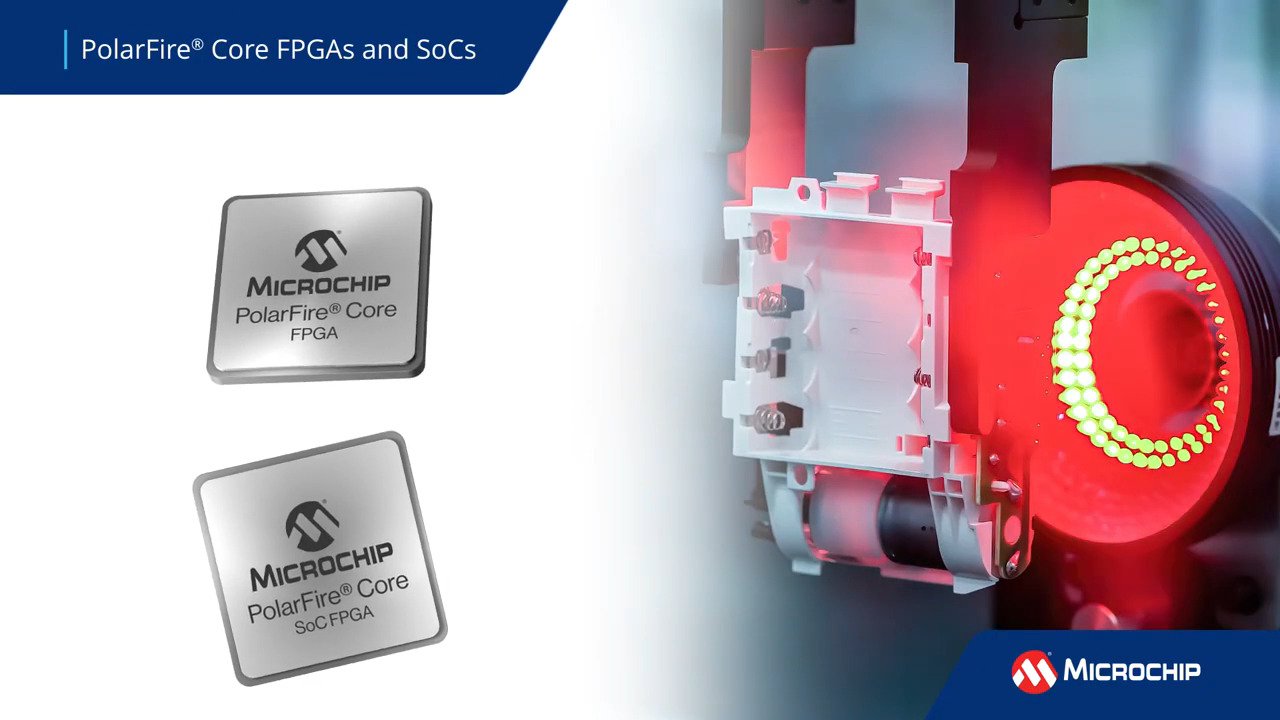
Alongside the RISC-V processor subsystem, the PolarFire SoC integrates an FPGA fabric (Figure 2) that enables developers to build deterministic processing pathways for low-latency real-time applications and to implement custom hardware acceleration for AI inference pipelines. As part of the complete system, this fabric houses 23k logic elements and its own supplementary resources, enabling it to operate independently of the main processing cores.
 Figure 2: The Microchip PolarFire SoC family combines multiple RISC-V processing cores with a versatile FPGA fabric for deterministic workloads. (Image source: Microchip Technology)
With multiple secure boot options, the PolarFire SoC’s integrated hardware security features allow developers to implement an in-depth security model, making it a useful platform for meeting modern cybersecurity requirements. These features include:
- Immutable hardware root-of-trust via physically unclonable function (PUF)
- Secure key storage with one-time programmable (OTP) or secure nonvolatile storage using Unique Device Secrets (UDS) and hardware-enforced key access control
- An anti-tamper module
Beyond this, the BeagleV-Fire offers several integrated physical ports for building an application-ready system in which custom Linux distributions can be verified and tested (Figure 3). These include an RJ45 Gigabit Ethernet port, a USB Type-C port for power and connectivity, an M.2 Key E socket, two 46-pin BeagleBone-compatible Cape headers for greater ecosystem expansion, and a Camera Serial Interface (CSI) for direct integration. A JTAG TAG-CONNECT footprint is provided for debugging, and the BeagleV-Fire also supports SYZYGY-compatible expansion for FPGA-oriented peripherals.
 Figure 3: Despite its small footprint, the BeagleBoard.org BeagleV-Fire offers several physical ports for immediate application interfacing. (Image source: BeagleBoard.org)
How to build an initial Linux configuration on the BeagleV-Fire SBC
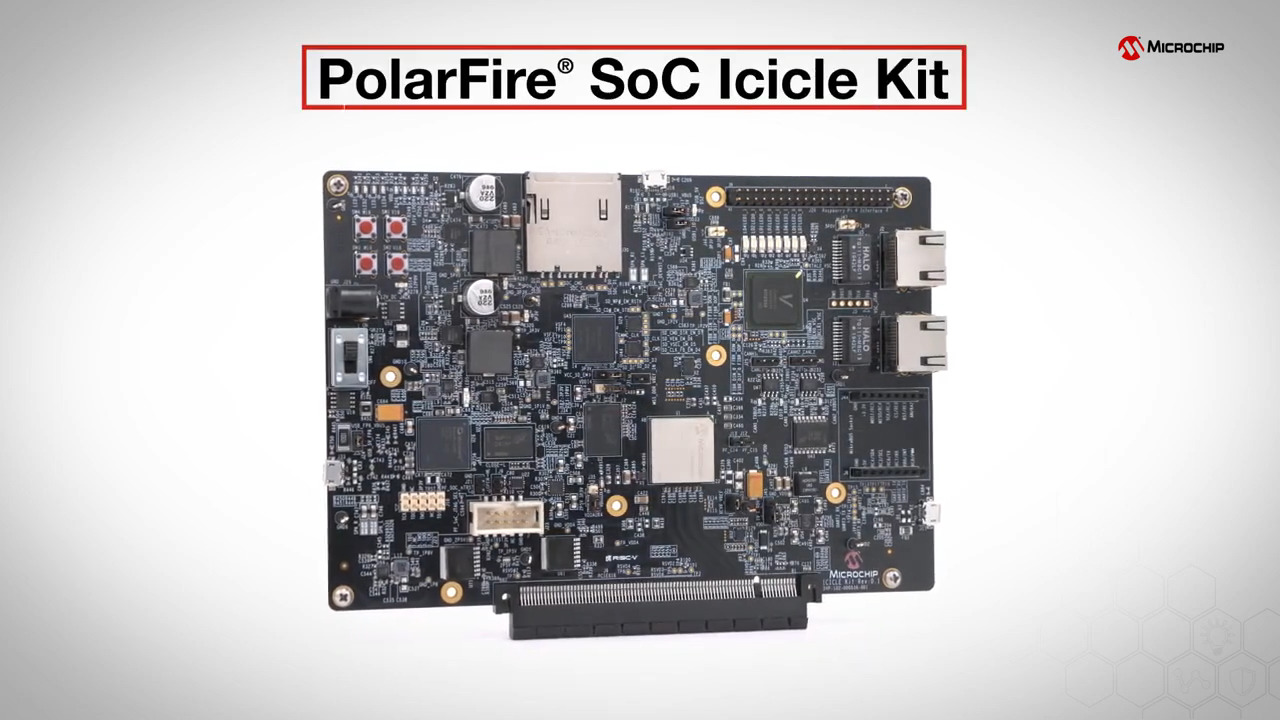
When building a lightweight Linux distribution for the BeagleV-Fire, developers must first obtain a suitable Yocto Project BSP layer. This will provide the U-Boot configuration, the default Linux kernel configuration, device trees to support the board, and peripheral support definitions. A GitHub repository supports all PolarFire SoC evaluation kit BSPs, including the BeagleV-Fire.
After installing all the required Yocto Project dependencies, the following layers provide the basis of the build and will need to be cloned:
- bitbake
- meta-openembedded-core
- meta-yocto (for the Poky reference distribution)
- meta-mchp-common
- meta-mchp-polarfire-soc/meta-mchp-polarfire-soc-bsp
- meta-mchp-polarfire-soc/meta-mchp-polarfire-soc-community
- Additional layers as required by the project
Once this is done, a minimal image can be built using the target of MACHINE = "beaglev-fire" and a kas configuration file. Listing 1 shows a sample configuration:
Copy
header:
  version: 19

repos:
  openembedded-core:
    url: git://git.openembedded.org/openembedded-core.git
    # yocto-5.0.15
    commit: 6988157ad983978ffd6b12bcefedd4deaffdbbd1
    layers:
      meta:

  bitbake:
    url: git://git.openembedded.org/bitbake.git
    # yocto-5.0.15
    commit: 8dcf084522b9c66a6639b5f117f554fde9b6b45a
    layers:
      bitbake: disabled

  meta-yocto:
    url: git://git.yoctoproject.org/git/meta-yocto.git
    # yocto-5.0.15
    commit: 9bb6e6e8b016a0c9dfe290369a6ed91ef4020535
    layers:
      meta-poky:
      meta-yocto-bsp:

  meta-mchp:
    url: https://github.com/linux4microchip/meta-mchp.git
    branch: scarthgap
    path: layers/third-party/meta-mchp
    layers:
      meta-mchp-common:
      meta-mchp-polarfire-soc/meta-mchp-polarfire-soc-bsp:
      meta-mchp-polarfire-soc/meta-mchp-polarfire-soc-community:

machine: beaglev-fire


local_conf_header:
  Users: |
    EXTRA_IMAGE_FEATURES = "allow-empty-password empty-root-password \
allow-root-login"
Listing 1: Shown is a sample configuration file that creates all the build artifacts required to boot the BeagleV-Fire into a simple shell. (Listing source: Microchip Technology)
Running "kas build core-image-minimal" will then create all the build artifacts required to boot the BeagleV-Fire into a simple shell, including the U-Boot binaries and a FIT image containing the Linux kernel and modules, the device tree, and the root filesystem.
Having built a minimal Linux image for the BeagleV-Fire using the Yocto Project, it is then possible to follow the standard procedures to create a customized image and tailor the build to the project's exact requirements. In robotics and industrial systems, for example, Linux is often used alongside a more traditional RTOS, such as FreeRTOS or Zephyr, to enable advanced processing alongside time-critical operations. This functionality is well supported by BeagleV-Fire’s PolarFire SoC, which can be configured to run multiple operating systems or bare metal applications simultaneously.
Given that many embedded devices require a working life of 10 years or more, the combination of the open RISC-V ISA, Linux, and Yocto-based reproducibility enables PolarFire SoC-based platforms to adapt to emerging security threats and new application requirements through regular local or OTA updates. In this way, the BeagleV-Fire SBC provides an excellent starting point for open-source adoption, boosting the flexibility and longevity of intelligent edge systems.
Conclusion
Computational limits, deterministic latency requirements, security exposure, and long lifecycle demands can present legitimate challenges when running Linux in resource-constrained embedded systems. The BeagleBoard.org BeagleV-Fire SBC provides a hybrid architecture that combines RISC-V Linux capability with FPGA-based deterministic logic and hardware security features to overcome these challenges. When paired with the Yocto Project and Microchip’s open-source BSP layers, developers can use this platform to build tailored, traceable Linux distributions optimized for extended-life robotics, IIoT, and edge computing applications.

Disclaimer: The opinions, beliefs, and viewpoints expressed by the various authors and/or forum participants on this website do not necessarily reflect the opinions, beliefs, and viewpoints of DigiKey or official policies of DigiKey.